
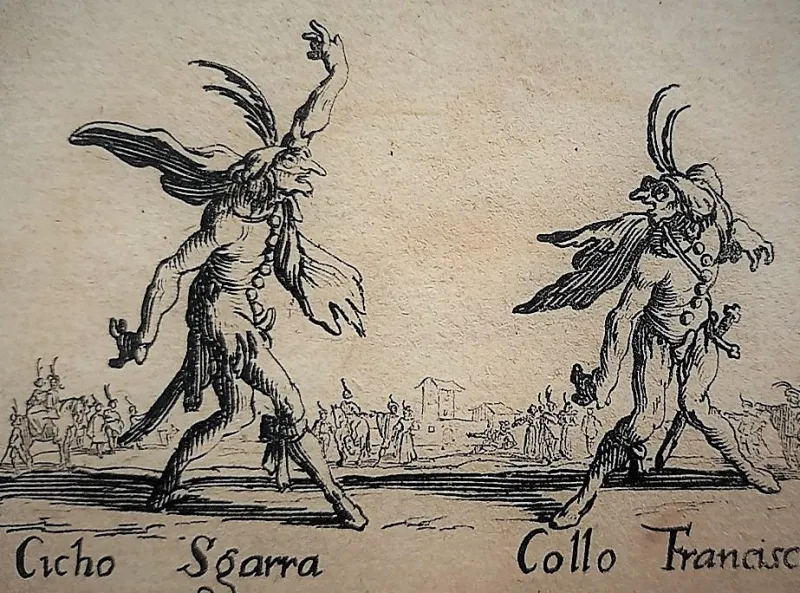
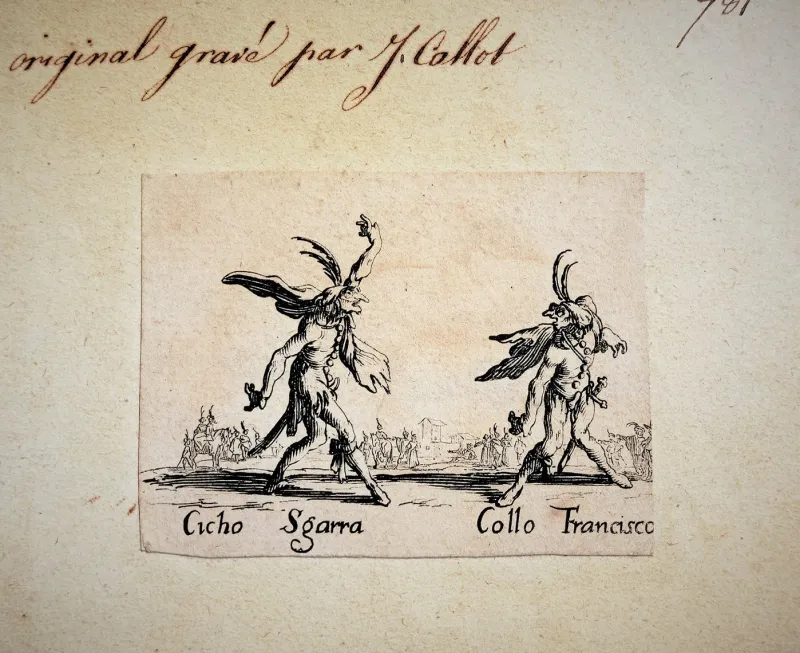
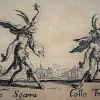
Sale Pamono Jacques Callot, Cicho Sgarra: Collo Francisco, 1622, Original Etching
$128.99
MAKER: Jacques Callot, 1592-1635, French, designerEditor: Israël Silvestre the younger, 1621-1691, French, publisherTIT…
Editor: Israël Silvestre the younger, 1621-1691, French, publisher
TITLE : Cicho Sgarra – Collo Francisco
YEAR : 1622
Portfolio: Balli di Sfessania
MEDIUM: etching
MATERIALS/TECHNIQUES
DIMENSIONS: 7.1 x 9.2 cm (2 13/16 x 3 5/8 inches) (plate)
SIGNATURE / INSCRIPTION / MARKS – In brown ink: Original grave par J.Callot
In Plate–In LL:Cicho Sgarra.; in LR:Collo Francisco.
Jacques Callot (1592-1632) was one of the earliest great creative artists to practice the graphic arts exclusively. His career can be divided into two periods: an Italian period, c. 1609-1621, and a Lorraine period from 1621 until his death. Callot studied the technique of engraving under Philippe Thomassin in Rome. About 1612 he joined Giulio Parigi in Florence. At that time Medici patronage expended itself almost exclusively on “feste,” and both Parigi and Callot were employed by Cosimo II (de Medici) to create visual records of these entertainments. Callots compositions are organized as if they were a stage setting and reduced the figures to a tiny scale, each one being rendered by the fewest possible strokes. This required an extremely fine etching technique. Callot enjoyed a lasting popularity all over Europe. He returned to Nancy after Cosimo*s death in 1621. During the Lorraine period Callot illustrated sacred books, made a series of plates of the Apostles, and visited Paris to make animated maps of the sieges of La Rochelle and the Ile de RÈ. Callot was one of the first etchers to used the technique of repeated biting, and sometimes combined graver work with etching
BALLI DI SFESSANIA
from a series of twenty-four plates, most likely published in Nancy c.1622 after compositions designed in Florence; rather than characters from the commedia dell’arte, the figures are to be identified as street-performers engaged in a dance called ‘sfessania’.
The prints in this series – Callot’s most exuberant and delightful – depict dances known in Neapolitan dialect as the sfessania. Such dances, as Callot’s etchings demonstrate in salacious detail, are characterized by violent and sometimes obscene physical contortions and gesticulations. Each plate features a pair of figures pulled from the repertoire of popular entertainers, their balletic interactions running a comic gamut from mock grace to blatant crudity.
The seller assumes all responsibility for this listing.
About This Piece
Editor: Israël Silvestre the younger, 1621-1691, French, publisher
TITLE : Cicho Sgarra – Collo Francisco
YEAR : 1622
Portfolio: Balli di Sfessania
MEDIUM: etching
MATERIALS/TECHNIQUES
DIMENSIONS: 7.1 x 9.2 cm (2 13/16 x 3 5/8 inches) (plate)
SIGNATURE / INSCRIPTION / MARKS – In brown ink: Original grave par J.Callot
In Plate–In LL:Cicho Sgarra.; in LR:Collo Francisco.
Jacques Callot (1592-1632) was one of the earliest great creative artists to practice the graphic arts exclusively. His career can be divided into two periods: an Italian period, c. 1609-1621, and a Lorraine period from 1621 until his death. Callot studied the technique of engraving under Philippe Thomassin in Rome. About 1612 he joined Giulio Parigi in Florence. At that time Medici patronage expended itself almost exclusively on “feste,” and both Parigi and Callot were employed by Cosimo II (de Medici) to create visual records of these entertainments. Callots compositions are organized as if they were a stage setting and reduced the figures to a tiny scale, each one being rendered by the fewest possible strokes. This required an extremely fine etching technique. Callot enjoyed a lasting popularity all over Europe. He returned to Nancy after Cosimo*s death in 1621. During the Lorraine period Callot illustrated sacred books, made a series of plates of the Apostles, and visited Paris to make animated maps of the sieges of La Rochelle and the Ile de RÈ. Callot was one of the first etchers to used the technique of repeated biting, and sometimes combined graver work with etching
BALLI DI SFESSANIA
from a series of twenty-four plates, most likely published in Nancy c.1622 after compositions designed in Florence; rather than characters from the commedia dell’arte, the figures are to be identified as street-performers engaged in a dance called ‘sfessania’.
The prints in this series – Callot’s most exuberant and delightful – depict dances known in Neapolitan dialect as the sfessania. Such dances, as Callot’s etchings demonstrate in salacious detail, are characterized by violent and sometimes obscene physical contortions and gesticulations. Each plate features a pair of figures pulled from the repertoire of popular entertainers, their balletic interactions running a comic gamut from mock grace to blatant crudity.
Click here for full descriptionClose description
| Period | Before 1890 |
|---|---|
| Year | 1622 |
| Production Period | Unknown |
| Country of Manufacture | France |
| Identifying Marks | This piece has an attribution mark |
| Style | Old Masters |
| Detailed Condition | Very Good — This vintage/antique item has no defects, but it may show slight traces of use. |
| Restoration and Damage Details | Patina consistent with age and use |
| Product Code | NRC-1388843 |
| Materials | Etching |
| Color | Black |
| Width | 7 cm 2.8 inch |
| Depth | 1 cm 0.4 inch |
| Height | 9 cm 3.5 inch |
Be the first to review “Sale Pamono Jacques Callot, Cicho Sgarra: Collo Francisco, 1622, Original Etching”
Related products
Beds & Bedroom Sets


Cabinets & Wardrobes
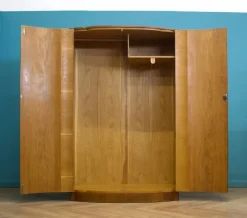
Cabinets & Wardrobes
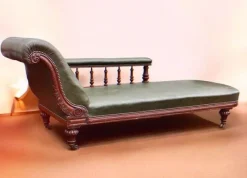
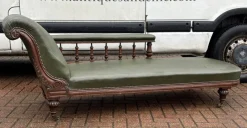
Daybeds & Chaises Lounges
New Pamono Antique Victorian Oak Chaise Longue in Green Leather with Brass Castors
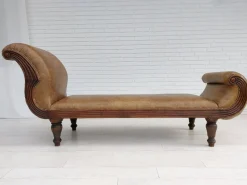
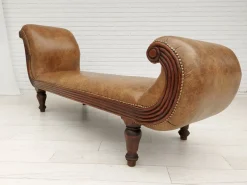
Daybeds & Chaises Lounges


Coffee & Side Tables
Sale Pamono Helix Spiral Sculptural Glass Coffee Table in the style of Danny Lane, 1980s


Login
Reviews
There are no reviews yet.