
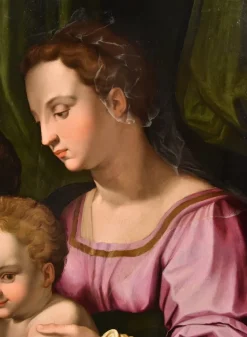
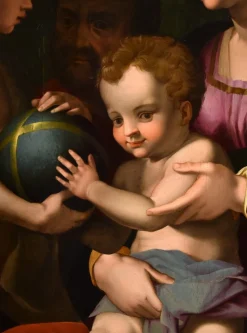
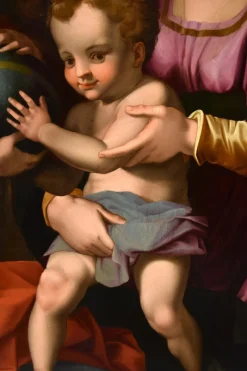
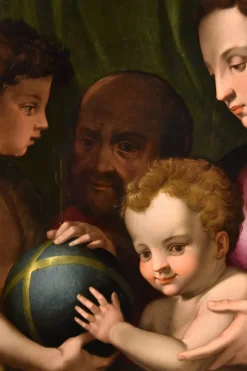
Pamono Agnolo di Cosimo alias Il Bronzino, Holy Family with Madonna & St John, 1550s, Oil on Panel> Old Masters|Classical
$138.89
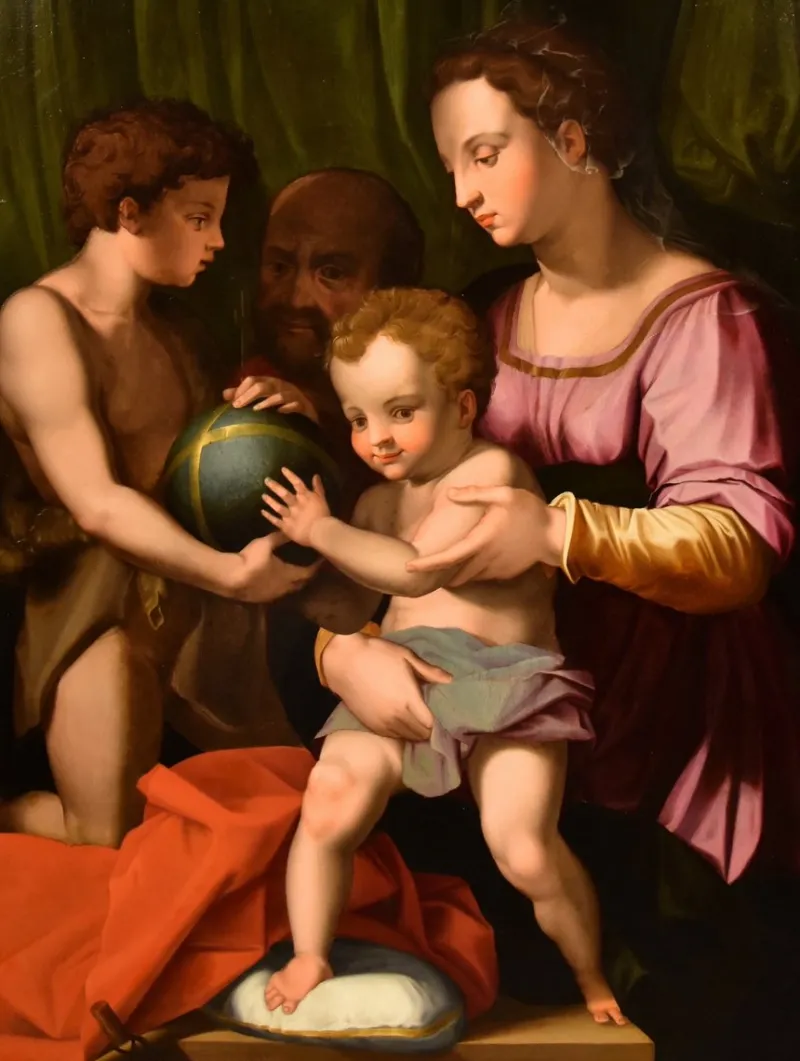
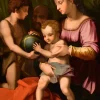
Agnolo di Cosimo, known as ‘il Bronzino’ (Monticelli di Firenze, 1503 – Florence, 1572)The Holy Family with the Infant…
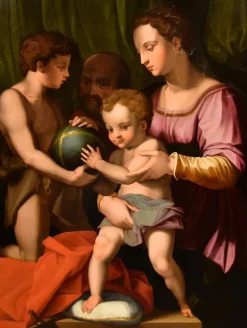
The Holy Family with the Infant Saint John the Baptist
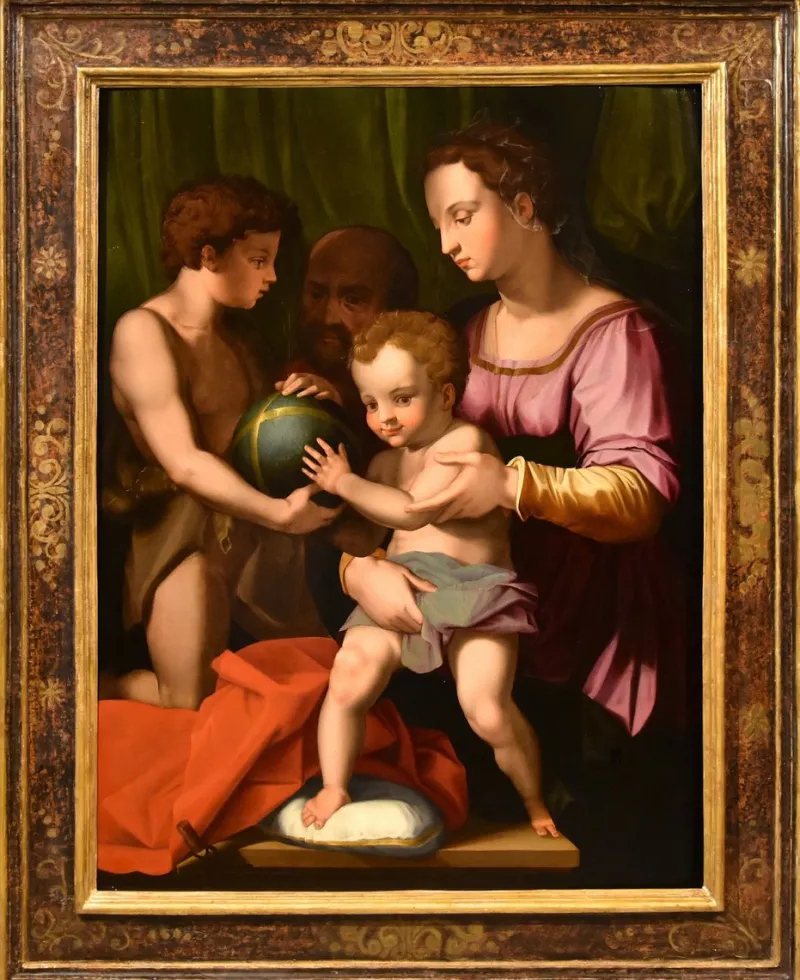
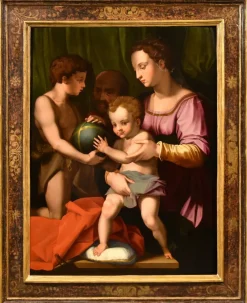
Oil on panel (120 x 90 cm. – In an old frame 146 x 116 cm.)
The work comes with the expertise of Professor Stephan D. Pepper, dated 5.12.96 (Rome)
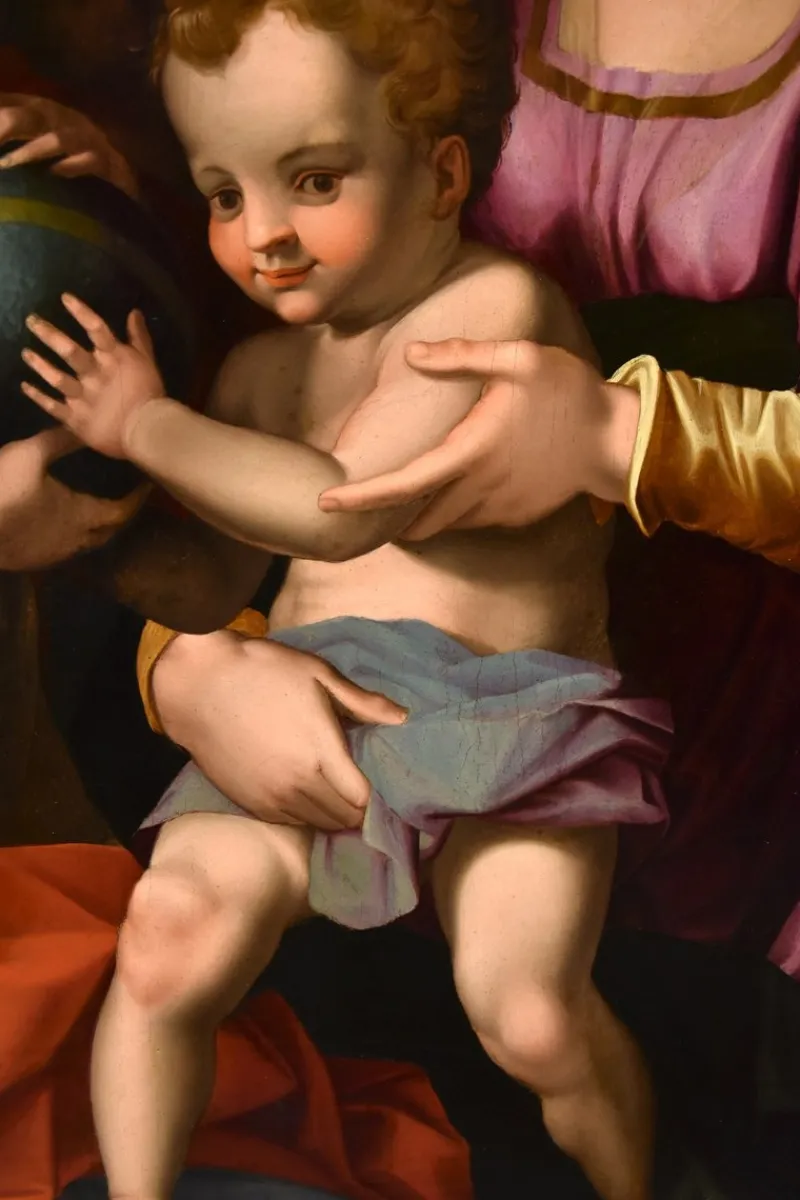
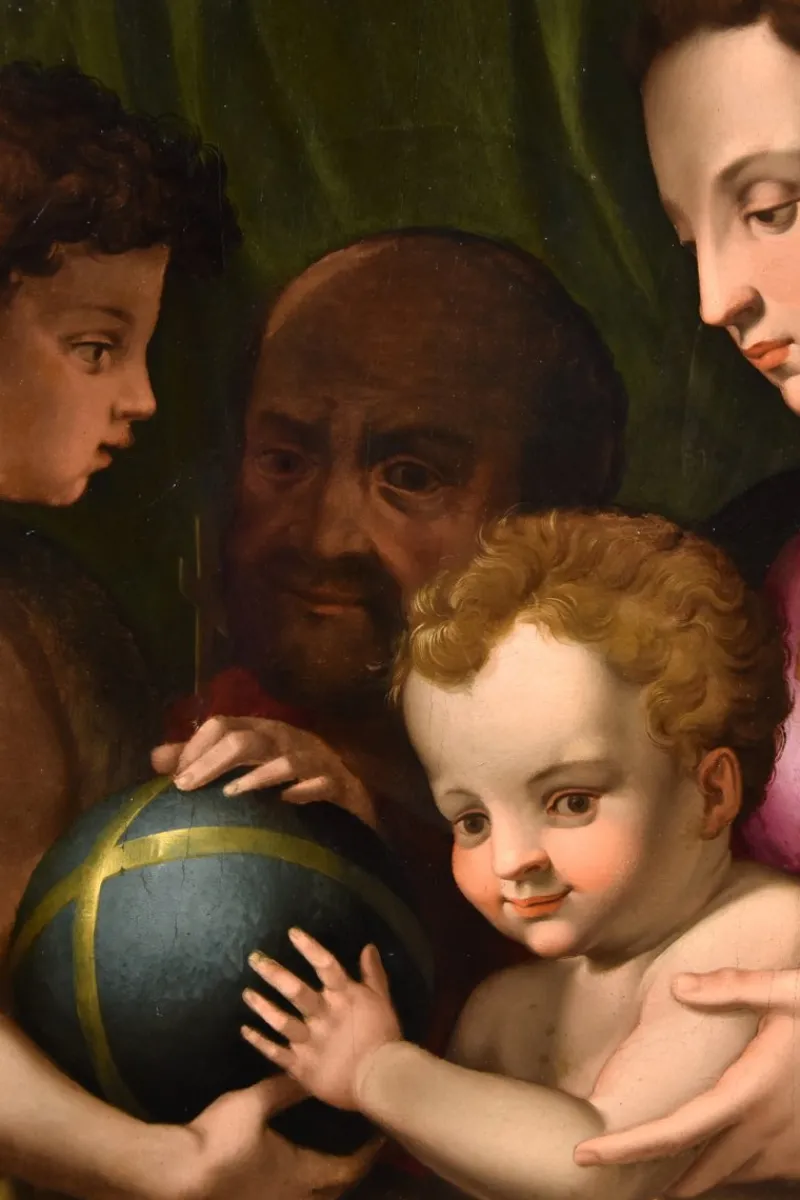
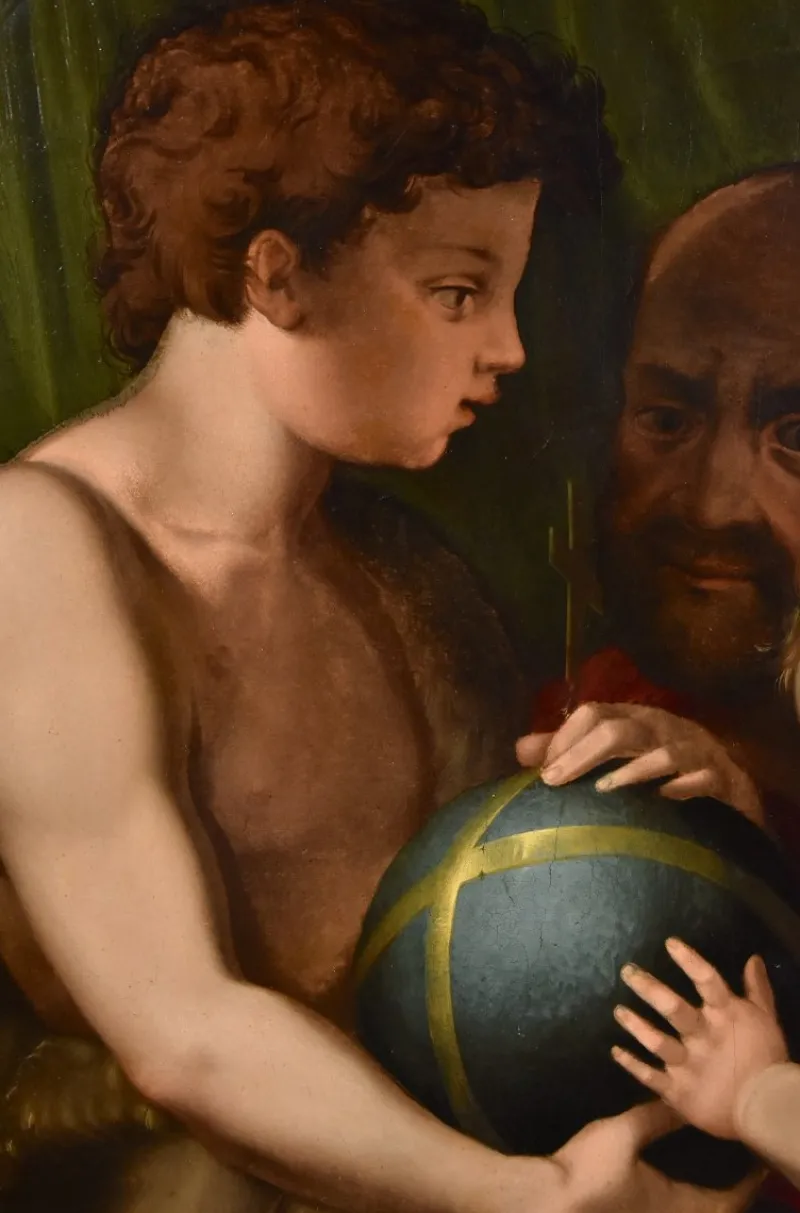
A painting of great charm and collector’s importance is examined, a high-quality version of the very famous ‘Holy Family with the Infant Saint John the Baptist’ made in 1528 by Andrea del Sarto (Florence 1486 – 1530), one of the most excellent exponents among the protagonists of the full Florentine Renaissance.
Better known as the “Holy Family Borgherini” from the name of the patron Giovanni Borgherini, a member of one of the most important Florentine families of the time, it is now kept at the Metropolitan Museum in New York (Inv. 22.75).
Information on the museum’s official website (link)
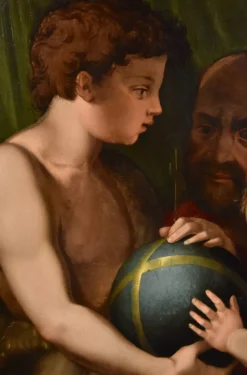
with this grandly solemn composition, Sarto confirmed that he was “the painter without defects”, as Giorgio Vasari loved to define him: his figures are masterfully drawn, rendered with a splendid chromatic harmony, and finally the relationship between the figures, arranged with an air of nobility, gives us a sublime choreography that unites the four characters.
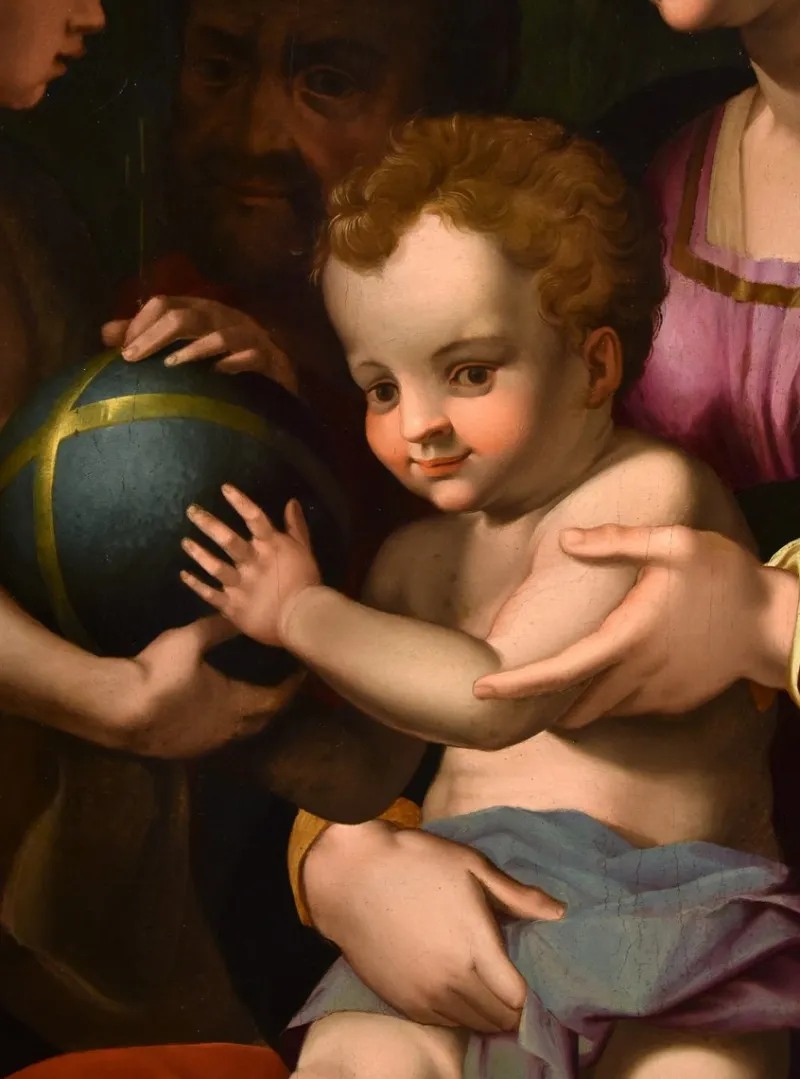
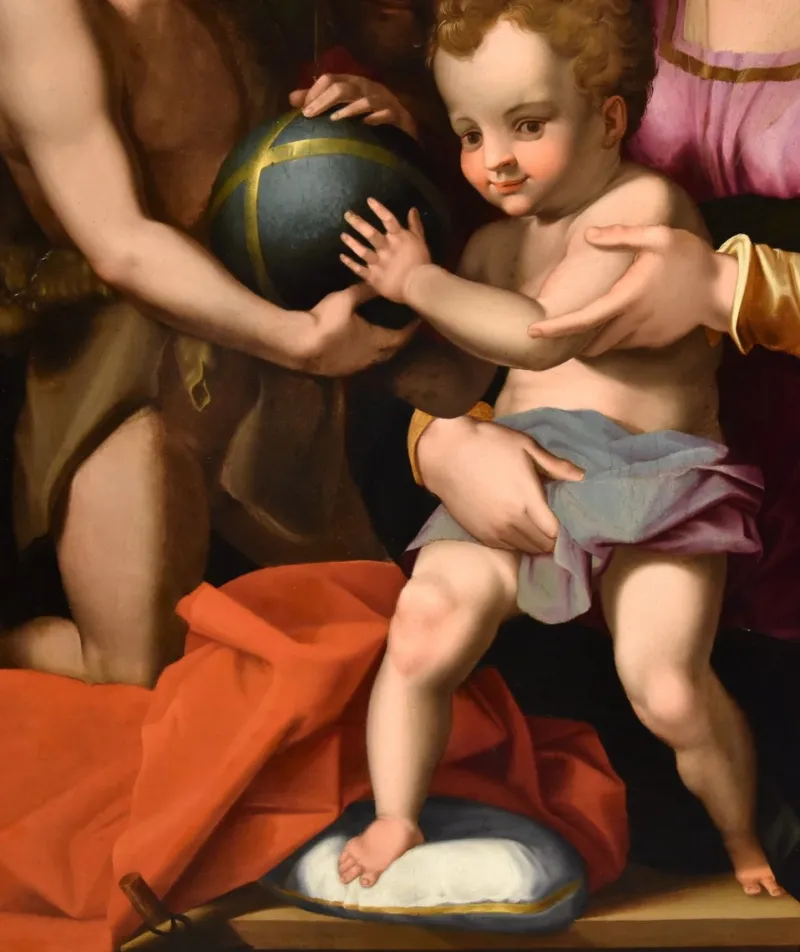
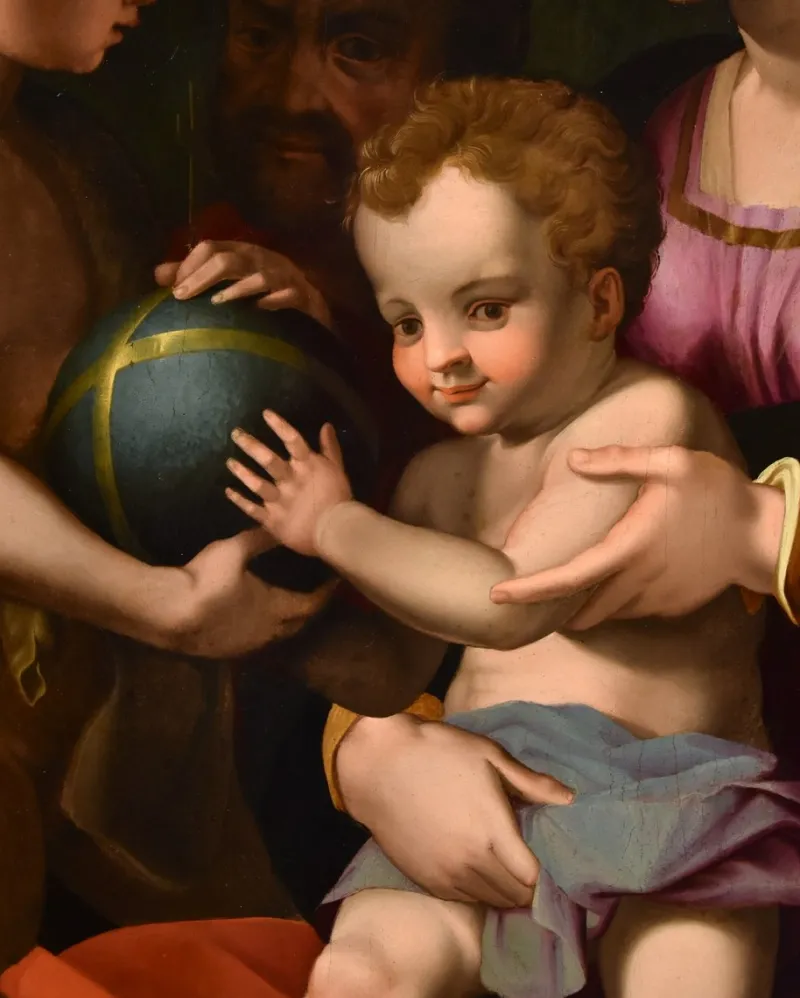
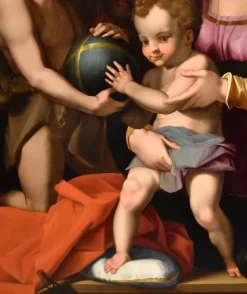
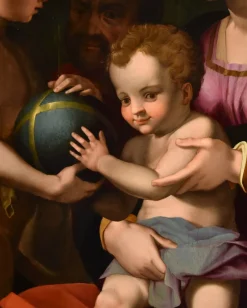
The painting, commissioned in the same year in which Florence managed to free itself from the dominion of the Medici and declared itself a Republic, also contains a political meaning, with John the Baptist, the city’s patron saint, who offers the globe with the cross to the little Baby Jesus, while continuing to hold it with his hands, to symbolize that both – therefore both the city and the Church – will act as protectors and guarantors of the freedom of the Florentine Republic.
Considered one of the most important jewels of the Florentine Renaissance, a masterpiece of the painter’s early maturity, it was one of the artist’s most admired and copied compositions, enjoying particular success with Florentine collectors already at the time: this explains the numerous copies, autographed or from the workshop, which enrich just as many international museums [1].
Although there is not, in terms of composition, a perfect correspondence between the original and the painting we are proposing – which in fact slavishly follows its compositional structure – there are also differences in the pictorial layout and in the consequent appearance.
The very high pictorial quality that distinguishes this work allows us to associate its authorship with a leading Florentine artist of the early sixteenth century, who was able to restore all the original poetry, albeit personalizing it with his own stylistic imprint.
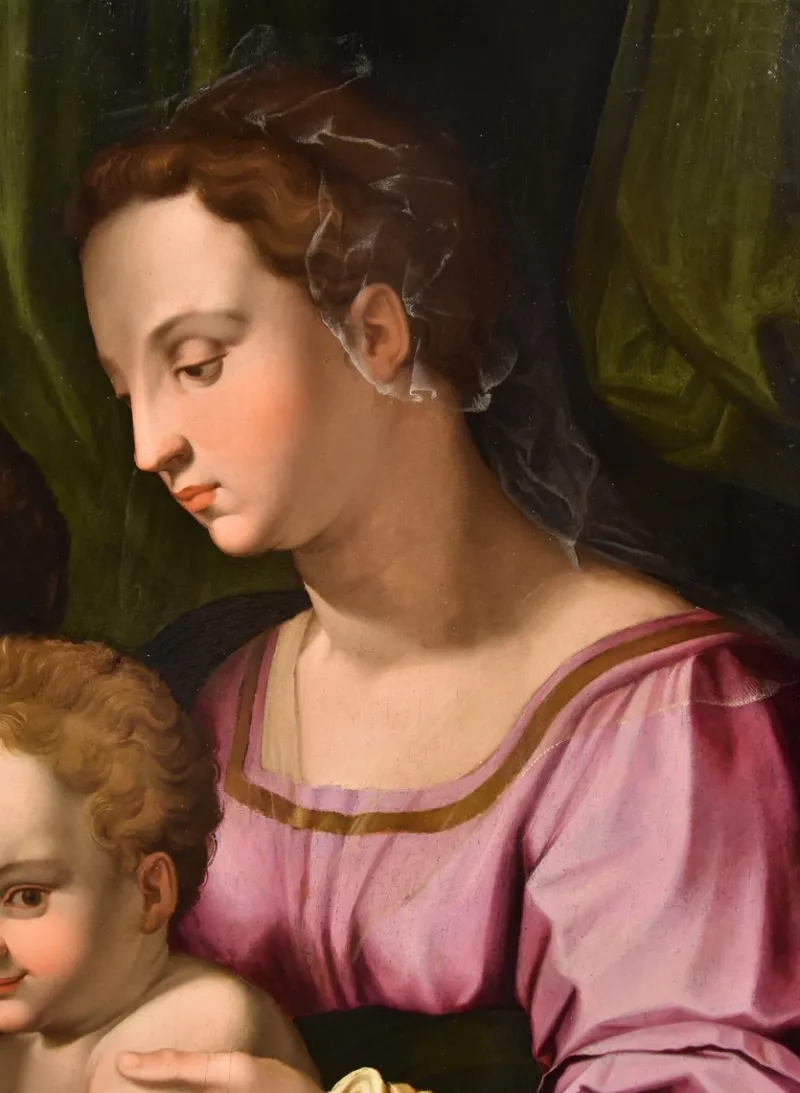
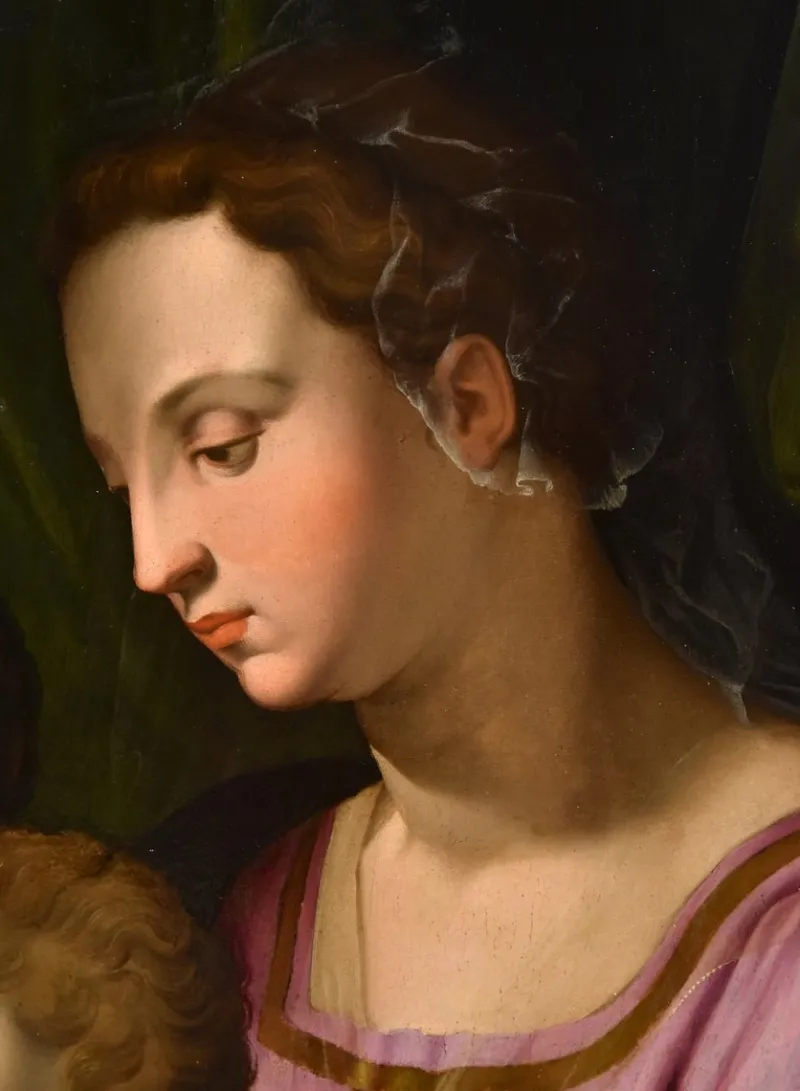
In particular, the uniformly applied pictorial material and the superb use of sfumato, with a modeling that leads us – as suggested by Stephan D. Pepper in his report – to rediscover the youthful hand of Agnolo di Cosimo, Bronzino (Monticelli di Firenze, 1503 – Florence, 1572), an undisputed master for the accuracy in the application of the pictorial material and the ‘glazing’ treatment, with which he made his painting enameled and transparent.
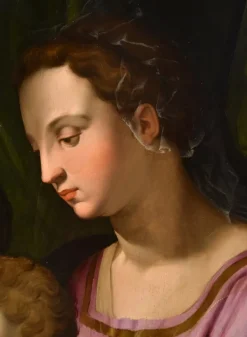
Bronzino developed an unmistakable style from his first works, unique for its elegance, compositional balance, and chromatic splendor, with a unique pictorial power made possible by a modeling with decisive lines, which gives the figures a sculptural and smooth appearance similar to porcelain.
Elements such as the spots of light that illuminate the subjects, or the semi-transparent veil of the Madonna have been rendered here in a virtuoso way.
[1] Among the various copies inspired by the Holy Family Bolgherini, made both by the workshop of Sarche and by contemporary authors, and now held in private and public collections we can mention:– Florence, Uffizi Palazzo Pitti: link
– Cesare da Sesto, Candiani Milan: link
– Christie’s Auction Rome, 5 Jun 2000: link
– Sotheby’s Auction New York, 9 January 1980: link
– Bonaiuti Collection, Rome (Lazio, Italy): link
– Gasparrini, Rome (attr. Circignani Nicolò called Pomarancio): link
The canvas is in excellent condition. Complete with antique frame.
ADDITIONAL INFORMATION:
The work is sold with a certificate of guarantee and authenticity, and a descriptive iconographic sheet.
We take care of and organize the transport of the purchased works, both for Italy and abroad, through professional and insured carriers.
It is our duty to warn you that, given the delicacy of some particular antique frames, there is the possibility that small lesions of the gilding may occur during transport, despite the packaging being carried out with the utmost care.
The seller assumes all responsibility for this listing.
About This Piece
The Holy Family with the Infant Saint John the Baptist
Oil on panel (120 x 90 cm. – In an old frame 146 x 116 cm.)
The work comes with the expertise of Professor Stephan D. Pepper, dated 5.12.96 (Rome)
A painting of great charm and collector’s importance is examined, a high-quality version of the very famous ‘Holy Family with the Infant Saint John the Baptist’ made in 1528 by Andrea del Sarto (Florence 1486 – 1530), one of the most excellent exponents among the protagonists of the full Florentine Renaissance.
Better known as the “Holy Family Borgherini” from the name of the patron Giovanni Borgherini, a member of one of the most important Florentine families of the time, it is now kept at the Metropolitan Museum in New York (Inv. 22.75).
Information on the museum’s official website (link)
with this grandly solemn composition, Sarto confirmed that he was “the painter without defects”, as Giorgio Vasari loved to define him: his figures are masterfully drawn, rendered with a splendid chromatic harmony, and finally the relationship between the figures, arranged with an air of nobility, gives us a sublime choreography that unites the four characters.
The painting, commissioned in the same year in which Florence managed to free itself from the dominion of the Medici and declared itself a Republic, also contains a political meaning, with John the Baptist, the city’s patron saint, who offers the globe with the cross to the little Baby Jesus, while continuing to hold it with his hands, to symbolize that both – therefore both the city and the Church – will act as protectors and guarantors of the freedom of the Florentine Republic.
Considered one of the most important jewels of the Florentine Renaissance, a masterpiece of the painter’s early maturity, it was one of the artist’s most admired and copied compositions, enjoying particular success with Florentine collectors already at the time: this explains the numerous copies, autographed or from the workshop, which enrich just as many international museums [1].
Although there is not, in terms of composition, a perfect correspondence between the original and the painting we are proposing – which in fact slavishly follows its compositional structure – there are also differences in the pictorial layout and in the consequent appearance.
The very high pictorial quality that distinguishes this work allows us to associate its authorship with a leading Florentine artist of the early sixteenth century, who was able to restore all the original poetry, albeit personalizing it with his own stylistic imprint.
In particular, the uniformly applied pictorial material and the superb use of sfumato, with a modeling that leads us – as suggested by Stephan D. Pepper in his report – to rediscover the youthful hand of Agnolo di Cosimo, Bronzino (Monticelli di Firenze, 1503 – Florence, 1572), an undisputed master for the accuracy in the application of the pictorial material and the ‘glazing’ treatment, with which he made his painting enameled and transparent.
Bronzino developed an unmistakable style from his first works, unique for its elegance, compositional balance, and chromatic splendor, with a unique pictorial power made possible by a modeling with decisive lines, which gives the figures a sculptural and smooth appearance similar to porcelain.
Elements such as the spots of light that illuminate the subjects, or the semi-transparent veil of the Madonna have been rendered here in a virtuoso way.
[1] Among the various copies inspired by the Holy Family Bolgherini, made both by the workshop of Sarche and by contemporary authors, and now held in private and public collections we can mention:– Florence, Uffizi Palazzo Pitti: link
– Cesare da Sesto, Candiani Milan: link
– Christie’s Auction Rome, 5 Jun 2000: link
– Sotheby’s Auction New York, 9 January 1980: link
– Bonaiuti Collection, Rome (Lazio, Italy): link
– Gasparrini, Rome (attr. Circignani Nicolò called Pomarancio): link
The canvas is in excellent condition. Complete with antique frame.
ADDITIONAL INFORMATION:
The work is sold with a certificate of guarantee and authenticity, and a descriptive iconographic sheet.
We take care of and organize the transport of the purchased works, both for Italy and abroad, through professional and insured carriers.
It is our duty to warn you that, given the delicacy of some particular antique frames, there is the possibility that small lesions of the gilding may occur during transport, despite the packaging being carried out with the utmost care.
Click here for full descriptionClose description
| Period | Before 1890 |
|---|---|
| Year | 1550 |
| Production Period | Before 1890 |
| Country of Manufacture | Italy |
| Identifying Marks | This piece is attributed to the above-mentioned designer/maker. It has no attribution mark |
| Style | Classical, Gothic, Italian, Louis XIII, Medieval, Old Masters, Religious, Renaissance, Tuscan |
| Detailed Condition | Good — This vintage/antique item may have some wear such as scratches and other signs of ageing. |
| Restoration and Damage Details | Light wear consistent with age and use, Patina consistent with age and use, Reupholstered, Partially restored |
| Product Code | CYT-2248541 |
| Materials | Oil |
| Color | Multicolored |
| Width | 116 cm 45.7 inch |
| Depth | 12 cm 4.7 inch |
| Height | 146 cm 57.5 inch |
Be the first to review “Pamono Agnolo di Cosimo alias Il Bronzino, Holy Family with Madonna & St John, 1550s, Oil on Panel> Old Masters|Classical”
Related products

Daybeds & Chaises Lounges
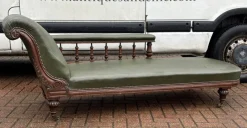
New Pamono Antique Victorian Oak Chaise Longue in Green Leather with Brass Castors



Coffee & Side Tables
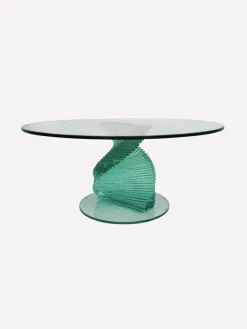
Sale Pamono Helix Spiral Sculptural Glass Coffee Table in the style of Danny Lane, 1980s



Dining Tables & Sets
New Pamono Vintage Table in Glass and Black Lacquered Metal, 1960s



Cabinets & Wardrobes

Daybeds & Chaises Lounges


Children's Chairs
Login
Reviews
There are no reviews yet.